“Vesting” decides how much of your employer’s contributions you keep if you leave your job. Your own contributions are always 100% vested. Employer match and profit-sharing money may vest over time.
The Two Main Types
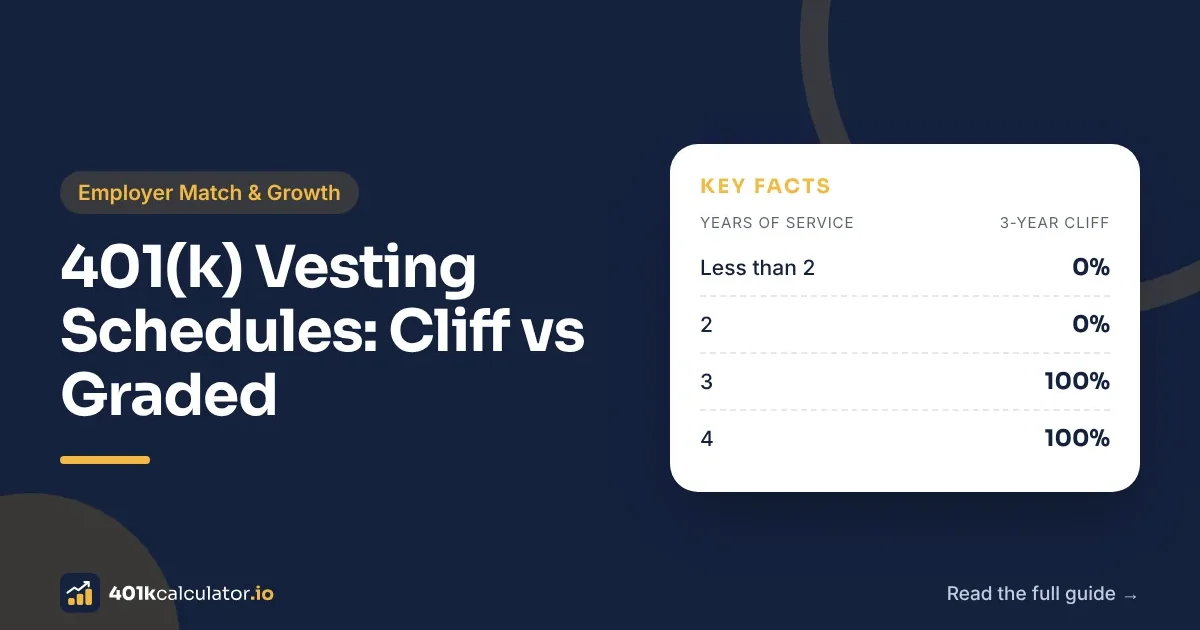
For employer matching contributions, federal law allows plans to be no slower than these:
| Years of service | 3-year cliff | 6-year graded |
|---|---|---|
| Less than 2 | 0% | 0% |
| 2 | 0% | 20% |
| 3 | 100% | 40% |
| 4 | 100% | 60% |
| 5 | 100% | 80% |
| 6 | 100% | 100% |
Plans can vest faster, including immediate vesting. Traditional safe harbor contributions must be 100% vested immediately (automatic-enrollment safe harbor plans, called QACAs, can require up to 2 years).
Example: What You’d Keep
Jordan has $9,000 of employer match in her account after 4 years. She’s leaving for a new job.
- Under a 3-year cliff: she keeps all $9,000.
- Under a 6-year graded schedule: she keeps 60%, or $5,400, and forfeits $3,600.
- Her own contributions and their growth: 100% hers either way.
How a “Year of Service” Is Counted
Many plans count a year in which you work at least 1,000 hours. Some use elapsed time from your hire date. Your plan document defines it.
Other Times You Become Fully Vested
You become 100% vested if:
- you reach the plan’s normal retirement age,
- the plan is terminated, or
- (in many plans) you die or become disabled while employed.
Should Vesting Affect When You Leave a Job?
Sometimes. If you’re a few weeks from a vesting milestone, staying a little longer could be worth thousands. Find your vesting status on your plan statement, which usually shows both “total balance” and “vested balance.”
When you do leave, only the vested balance can be rolled over. See What Happens to Your 401(k) When You Leave a Job.
FAQs
Does vesting apply to my Roth or pre-tax contributions? No. Anything you contribute from your paycheck is always fully vested.
What happens to forfeited money? It stays in the plan, where it can be used to pay plan expenses or reduce future employer contributions.
Does my calculator result include vesting? Our 401(k) calculator assumes you stay until retirement and become fully vested. If you might leave early, reduce the match accordingly.
Sources: IRS – Retirement topics: vesting · IRS – Issue snapshot: vesting schedules for matching contributions
Last reviewed: 15 Nov 2026 · Written and fact-checked by Zeeshan Nawaz