An employer match is money your company adds to your 401(k) when you contribute. The formula tells you how much they add and up to what point. Match formulas sound similar but can be worth very different amounts.
How to Read a Match Formula
Most formulas have two parts:
- The match rate – how much the employer adds per dollar you contribute (for example 50% or 100%).
- The cap – the share of your salary the employer will match (for example “up to 6% of pay”).
“50% up to 6%” means: for every dollar you contribute, up to 6% of your salary, your employer adds 50 cents.
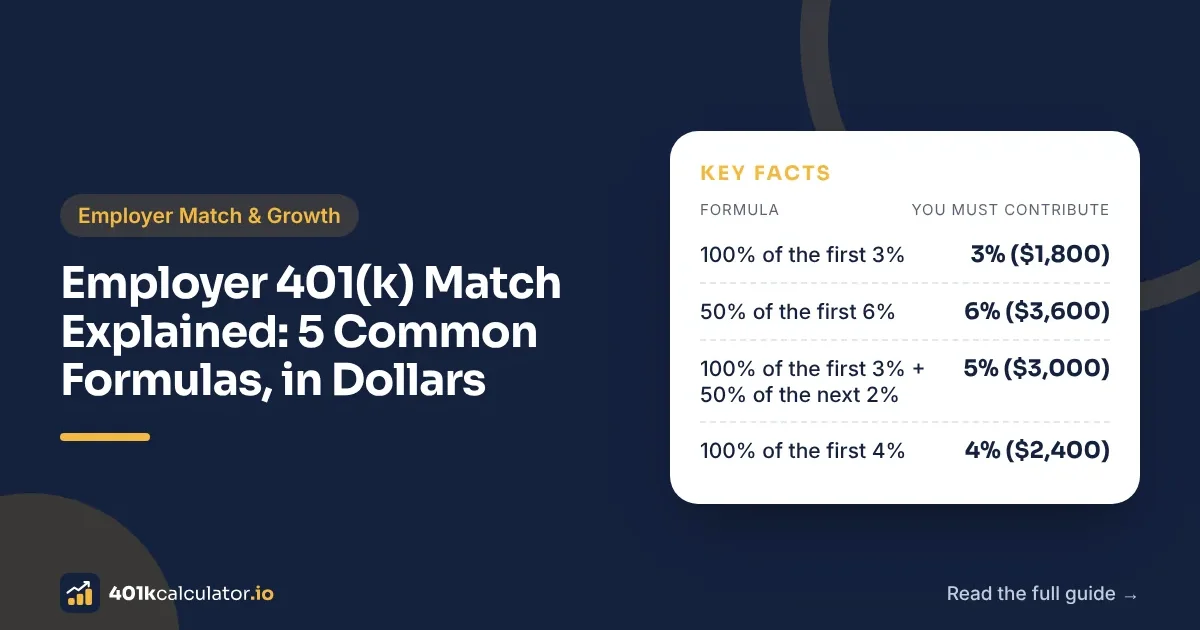
Five Common Formulas on a $60,000 Salary
| Formula | You must contribute | Employer adds | As % of salary |
|---|---|---|---|
| 100% of the first 3% | 3% ($1,800) | $1,800 | 3% |
| 50% of the first 6% | 6% ($3,600) | $1,800 | 3% |
| 100% of the first 3% + 50% of the next 2% (safe harbor basic) | 5% ($3,000) | $2,400 | 4% |
| 100% of the first 4% (safe harbor enhanced, common version) | 4% ($2,400) | $2,400 | 4% |
| 100% of the first 6% | 6% ($3,600) | $3,600 | 6% |
Notice that “100% of 3%” and “50% of 6%” give the same $1,800, but the second one requires you to contribute twice as much to get it.
Non-Elective Contributions
Some employers add a fixed percentage of pay, such as 3%, whether or not you contribute. This is called a non-elective contribution. It isn’t technically a match, but it adds to your account the same way. On $60,000, a 3% non-elective contribution is $1,800 a year.
Per-Paycheck vs Annual Matching
Many plans calculate the match each pay period. If you contribute a large share early and hit the annual limit before December, you may miss match in later paychecks unless the plan does a year-end “true-up.” See 401(k) True-Up Contributions.
Vesting: When the Match Becomes Yours
Your own contributions are always 100% yours. Employer contributions may vest over several years. If you leave before you’re fully vested, you can lose part of the match. See 401(k) Vesting Schedules.
How Much Is the Match Worth Over Time?
A $1,800 yearly match, invested at 7% for 30 years, grows to about $170,000 on its own. To see your own numbers, choose your plan’s formula in our 401(k) calculator and compare contribution rates.
How to Get the Full Match
- Find your formula in your plan’s Summary Plan Description or benefits portal.
- Set your contribution rate at least to the cap (for example 6% for “50% up to 6%”).
- Check that your plan doesn’t require a waiting period before the match starts.
- If you plan to max out early, ask HR whether the plan has a true-up.
FAQs
Does the match count toward my $24,500 limit? No. Only your own contributions count toward $24,500. The match counts toward the $72,000 total limit.
Is the match taxed? Employer matching contributions are usually pre-tax, so they are taxed when withdrawn. Since SECURE 2.0, plans may let you choose to receive the match as Roth, in which case it is included in your taxable income for that year.
Can my employer change or stop the match? Yes, employers can change the formula with notice. Safe harbor plans have stricter rules about mid-year changes.
Sources: IRS – 401(k) plans overview · IRS – 401(k) plan types (safe harbor) · Dollar examples calculated by 401kcalculator.io.
Last reviewed: 14 Nov 2026 · Written and fact-checked by Zeeshan Nawaz