If your employer matches each paycheck, reaching the $24,500 limit early in the year can stop your match for the rest of the year. A true-up is an extra employer contribution, usually made after year-end, that tops your match up to what it would have been had you contributed evenly.
Not every plan offers a true-up. If yours doesn’t, the timing of your contributions matters.
A Worked Example
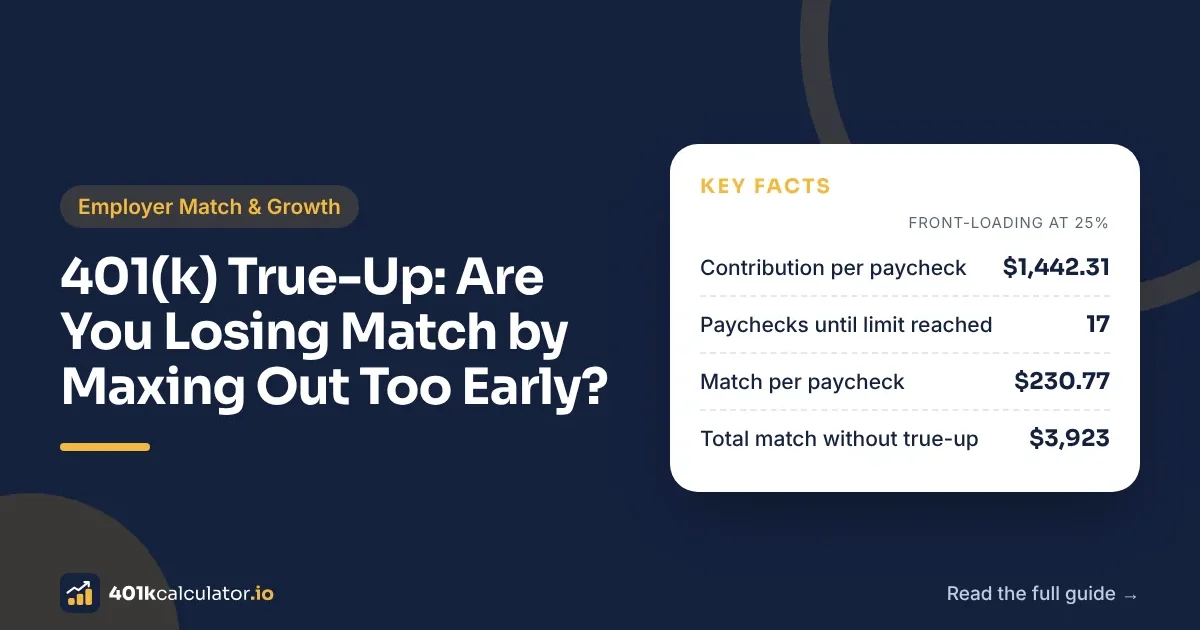
Sam earns $150,000, paid biweekly (26 paychecks of $5,769.23). His employer matches 100% of contributions up to 4% of pay, calculated per paycheck. Sam sets his contribution to 25% to max out quickly.
| Front-loading at 25% | Even contributions all year | |
|---|---|---|
| Contribution per paycheck | $1,442.31 | $942.31 |
| Paychecks until limit reached | 17 | 26 |
| Match per paycheck (4% of pay) | $230.77 | $230.77 |
| Total match without true-up | $3,923 | $6,000 |
| Match lost | $2,077 | $0 |
Sam still contributes $24,500 either way. But front-loading costs him $2,077 of free money if his plan has no true-up.
How to Find Out If Your Plan Has a True-Up
- Search your Summary Plan Description for “true-up” or “annual match calculation.”
- Ask HR or the plan administrator: “Is the match calculated per pay period or annually, and is there a year-end true-up?”
- Some plans require you to be employed on the last day of the year to get the true-up.
If There’s No True-Up
Spread your contributions so you reach the limit with your last paycheck of the year. Use the per-paycheck amounts in How to Max Out Your 401(k). For Sam, that’s $942.31 per paycheck.
If you get a raise or bonus mid-year, recalculate:
Per-paycheck amount = (Limit − Contributed so far) ÷ Paychecks left
When Front-Loading Can Still Make Sense
If your plan does a true-up, contributing early means your money is invested sooner. Over long periods that can add a little growth. Without a true-up, the lost match usually outweighs that small benefit.
Not sure how your plan’s match formula works? Start with employer 401(k) match explained, then test your own numbers in the 401(k) calculator.
FAQs
Is a true-up required by law? No. It is a plan design choice.
When is the true-up deposited? Usually in the first few months of the following year. Check your plan.
Does this matter if I don’t max out? Usually not. If you contribute the same percentage all year and never hit the limit, you get the match on every paycheck.
Sources: IRS – 401(k) plans · Example calculated by 401kcalculator.io.
Last reviewed: 15 Nov 2026 · Written and fact-checked by Zeeshan Nawaz