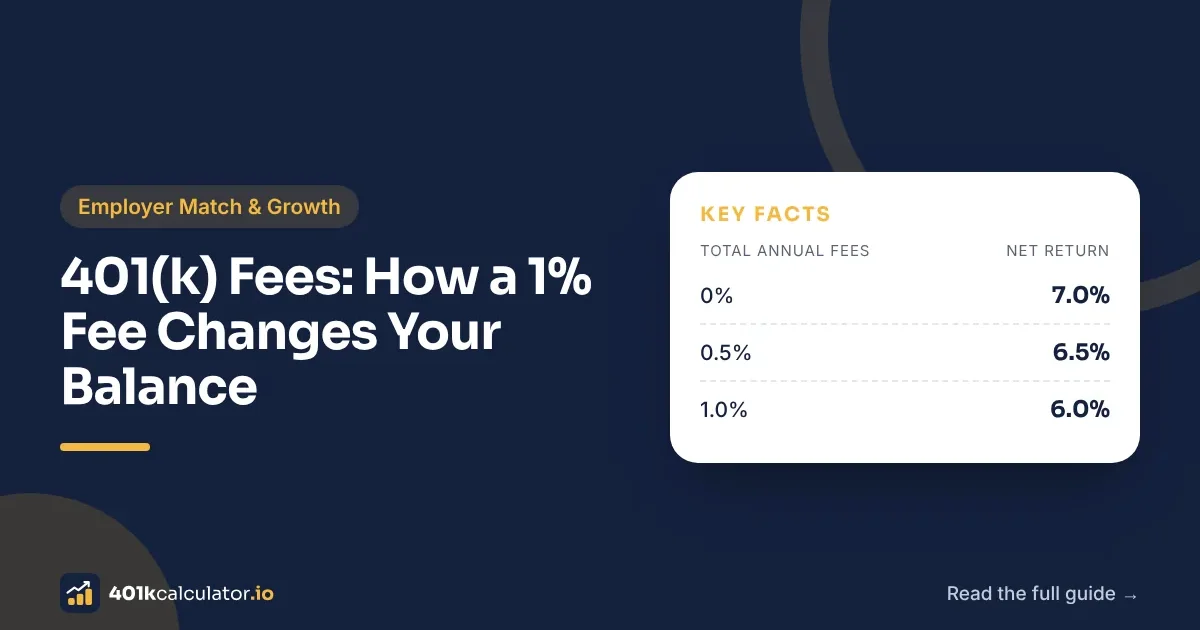
Fees are taken from your investment returns every year, so even small differences compound. Here’s the effect on someone contributing $10,000 a year for 30 years with a 7% return before fees.
| Total annual fees | Net return | Balance after 30 years | Lost to fees |
|---|---|---|---|
| 0% | 7.0% | $944,608 | — |
| 0.5% | 6.5% | $863,749 | $80,859 |
| 1.0% | 6.0% | $790,582 | $154,026 |
A 1% fee costs this saver about $154,000, roughly 16% of the no-fee balance.
Where 401(k) Fees Come From
- Investment fees (expense ratios). Charged by each fund, shown as a percentage. Index funds often charge much less than actively managed funds.
- Plan administration fees. Recordkeeping, legal and accounting costs. Sometimes paid by your employer, sometimes taken from accounts.
- Individual service fees. For loans, distributions or advice.
How to Find Your Fees
- Look for your plan’s annual fee disclosure (often called a 404a-5 notice) in your plan portal.
- Check each fund’s expense ratio in the investment menu.
- Review your quarterly statement for administrative charges.
How to Lower Them
- Choose lower-cost index funds or target-date index funds in your plan, if available.
- Avoid funds with sales charges.
- When you leave a job, compare your old plan’s costs with an IRA before deciding whether to roll over. See the Rollover Guide.
- Don’t give up the employer match to avoid fees. The match is usually worth far more.
Add Fees to Your Projection
Our 401(k) calculator has a fees field. Enter your total fund and plan fees to see their effect on your balance.
FAQs
What’s a reasonable 401(k) fee? It varies by plan size and fund choice. Compare your funds’ expense ratios with similar funds and ask your employer about plan costs.
Are fees tax-deductible? Fees paid from your 401(k) are not separately deductible.
Sources: U.S. Department of Labor – A Look at 401(k) Plan Fees · Calculations by 401kcalculator.io.
Last reviewed: 19 Nov 2026 · Written and fact-checked by Zeeshan Nawaz