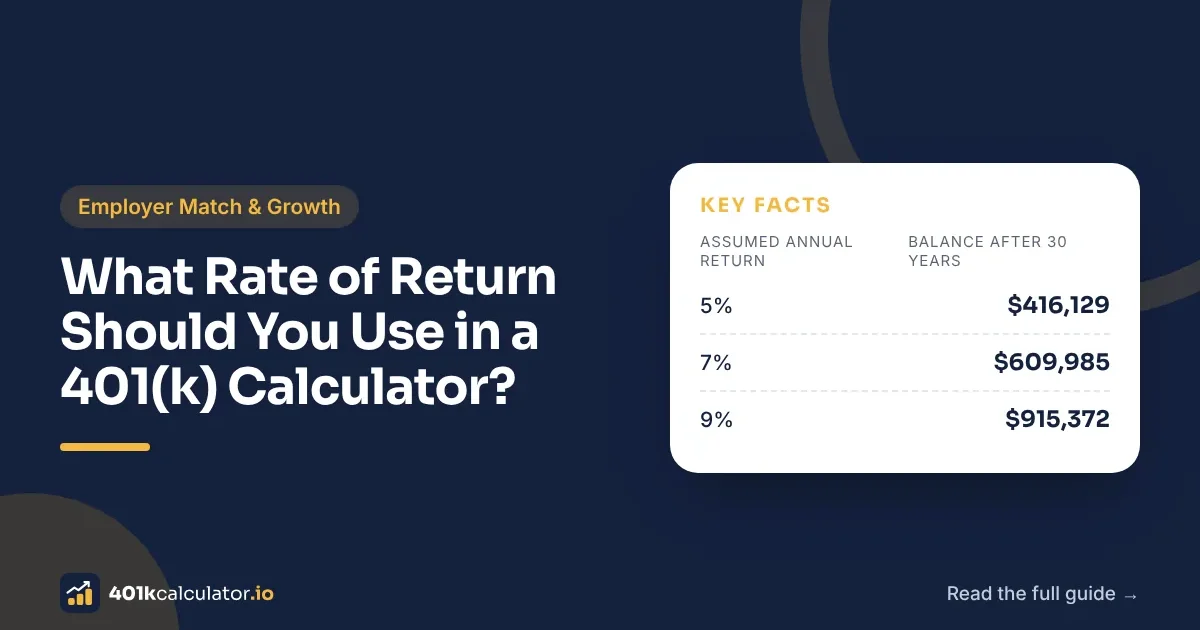
No one knows future returns, so the best approach is to test a range instead of trusting one number. Here’s how much the choice matters for $500 a month over 30 years:
| Assumed annual return | Balance after 30 years |
|---|---|
| 5% | $416,129 |
| 7% | $609,985 |
| 9% | $915,372 |
The 9% result is more than double the 5% result. That’s why one rate should never be treated as a forecast.
What Drives Your Return
- Your investment mix. Stocks have historically returned more than bonds over long periods, with bigger ups and downs. A target-date fund shifts from stocks to bonds as you near retirement, which usually lowers expected return over time.
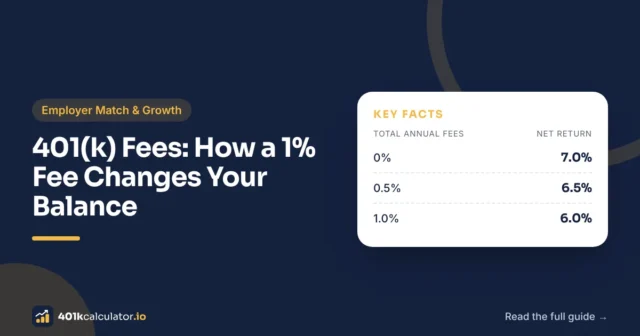
- Fees. Subtract your total fees from the return you assume. See 401(k) Fees.
- Inflation. A “nominal” return includes inflation; a “real” return removes it.
Nominal vs Real Returns
If you use a nominal return such as 7%, your result is in future dollars. To understand its buying power, convert it to today’s dollars, or use a real return (for example, 7% minus 2.5% inflation ≈ 4.5%). Our 401(k) calculator shows both. More in Inflation and Your 401(k).
A Practical Method
- Run a cautious case (for example 5%).
- Run a middle case (for example 7%).
- Run an optimistic case (for example 9%).
- Plan around the cautious-to-middle results. Treat the optimistic result as a bonus, not a plan.
Lower the rate further if you hold mostly bonds or cash, or if you’re within a few years of retirement.
Why Steady Returns Can Mislead
Calculators usually assume the same return every year. Real markets move unevenly, and a big drop right before or after retirement (sequence-of-returns risk) can hurt more than one decades earlier. Building in a margin, by saving a little more or using a cautious rate, helps.
See how a single return assumption plays out year by year in how 401(k) compound growth works. To test returns on money outside your 401(k), Tuff Search has a compound interest calculator.
FAQs
Is 10% a realistic return? Some long-run stock market averages are near that before inflation, but a diversified 401(k) with bonds and fees will usually earn less. Use it only as an optimistic scenario.
Should I change my rate as I get older? Yes. As your mix becomes more conservative, a lower assumption is reasonable.
Sources: Calculations by 401kcalculator.io (monthly compounding, contributions at month-end).
Last reviewed: 19 Nov 2026 · Written and fact-checked by Zeeshan Nawaz