Compound growth means your investment returns start earning returns of their own. In a 401(k), this happens without yearly taxes on gains, which is why time is such a big factor.
The Year-by-Year Picture
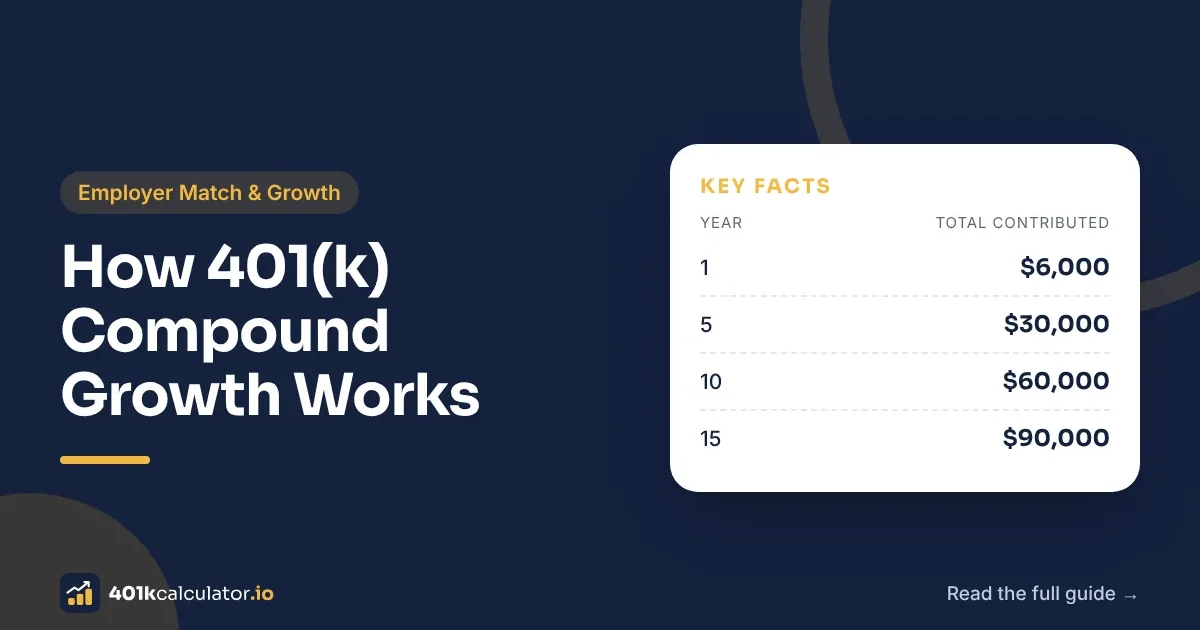
Suppose you contribute $6,000 a year (for example 10% of a $60,000 salary) and earn 7% a year, with contributions added at the end of each year.
| Year | Total contributed | Balance | Growth so far |
|---|---|---|---|
| 1 | $6,000 | $6,000 | $0 |
| 5 | $30,000 | $34,504 | $4,504 |
| 10 | $60,000 | $82,899 | $22,899 |
| 15 | $90,000 | $150,774 | $60,774 |
| 20 | $120,000 | $245,973 | $125,973 |
| 25 | $150,000 | $379,494 | $229,494 |
| 30 | $180,000 | $566,765 | $386,765 |
In the first 10 years, growth adds about $23,000. In the last 10 years alone, it adds far more, because the balance it compounds on is much larger. After 30 years, about two-thirds of the balance is growth.
The Formula
For a fixed yearly contribution C, return r and n years:
Future value = C × [(1 + r)^n − 1] ÷ r
Check: $6,000 × [(1.07)^30 − 1] ÷ 0.07 ≈ $566,765.
If you already have a balance B, add B × (1 + r)^n.
What Speeds It Up
- Starting earlier. Each extra year gives every dollar more time. See The Real Cost of Waiting.
- Employer match. More money compounding from the start.
- Lower fees. Fees reduce the rate that compounds every year. See 401(k) Fees.
- Raising contributions over time. Our calculator includes salary growth so your contribution rises with your pay.
What Slows It Down
- Withdrawals and loans that take money out of the market.
- High fees.
- Market drops, especially close to retirement. The steady 7% here is an average assumption, not how real markets behave year to year. See What Rate of Return to Use.
Try Your Own Numbers
Enter your salary, contribution rate and match into our 401(k) calculator to see your own year-by-year table.
A quick way to sense-check growth is the Rule of 72: divide 72 by your annual return to estimate how many years it takes money to double. Tuff Search explains the Rule of 72 with examples.
FAQs
Is compound growth guaranteed in a 401(k)? No. Returns depend on your investments. Values can fall.
Does a 401(k) compound monthly or yearly? Investments change in value continuously. Calculators use monthly or yearly steps to estimate it; results are close either way.
Sources: Calculations by 401kcalculator.io (end-of-year contributions, constant 7% return).
Last reviewed: 16 Nov 2026 · Written and fact-checked by Zeeshan Nawaz