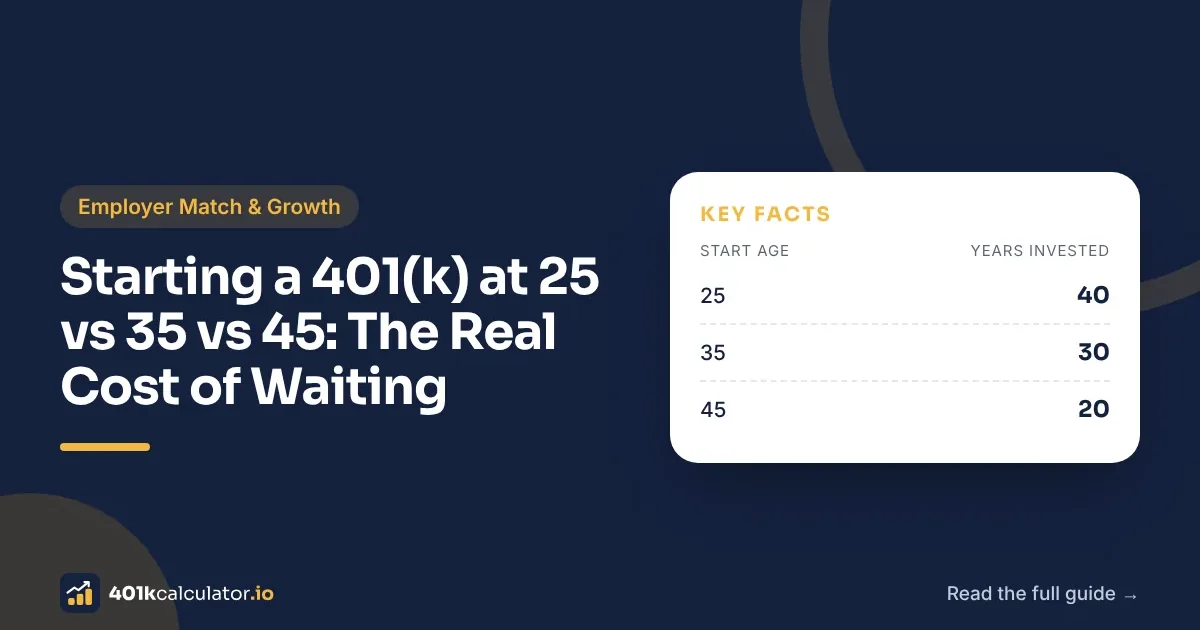
Time is the one input you can’t add later. Here’s what $500 a month, earning 7% a year (compounded monthly), grows to by age 65 depending on when you start.
| Start age | Years invested | Total contributed | Balance at 65 |
|---|---|---|---|
| 25 | 40 | $240,000 | $1,312,407 |
| 35 | 30 | $180,000 | $609,985 |
| 45 | 20 | $120,000 | $260,463 |
Starting at 25 instead of 35 means contributing $60,000 more, but ending with about $700,000 more. That difference is almost all compound growth.
How Much More Do You Need to Save If You Start Later?
To reach roughly the same $1.31 million by 65:
| Start age | Monthly contribution needed (7%) |
|---|---|
| 25 | $500 |
| 35 | about $1,076 |
| 45 | about $2,519 |
A 10-year delay roughly doubles the monthly amount needed; a 20-year delay roughly quintuples it.
What If You’re Already 35 or 45?
The best time to start was earlier; the next best time is now. Practical steps:
- Take the full employer match immediately.
- Increase contributions with each raise.
- Use catch-up contributions from 50. See Catch-Up Contributions.
- Consider working a couple of extra years.
Run Your Own Comparison
Put your age and a monthly contribution into our 401(k) calculator, then change only the start age to see the cost of waiting for you.
For the year-by-year maths behind these numbers, see how 401(k) compound growth works.
FAQs
Does this assume a steady 7% return? Yes. Real returns vary. The point is the relative effect of time, which holds across most realistic rates.
What if I can only afford $100 a month at 25? Start anyway. $100 a month at 7% for 40 years grows to about $262,000.
Sources: Calculations by 401kcalculator.io (monthly compounding, contributions at month-end).
Last reviewed: 18 Nov 2026 · Written and fact-checked by Zeeshan Nawaz