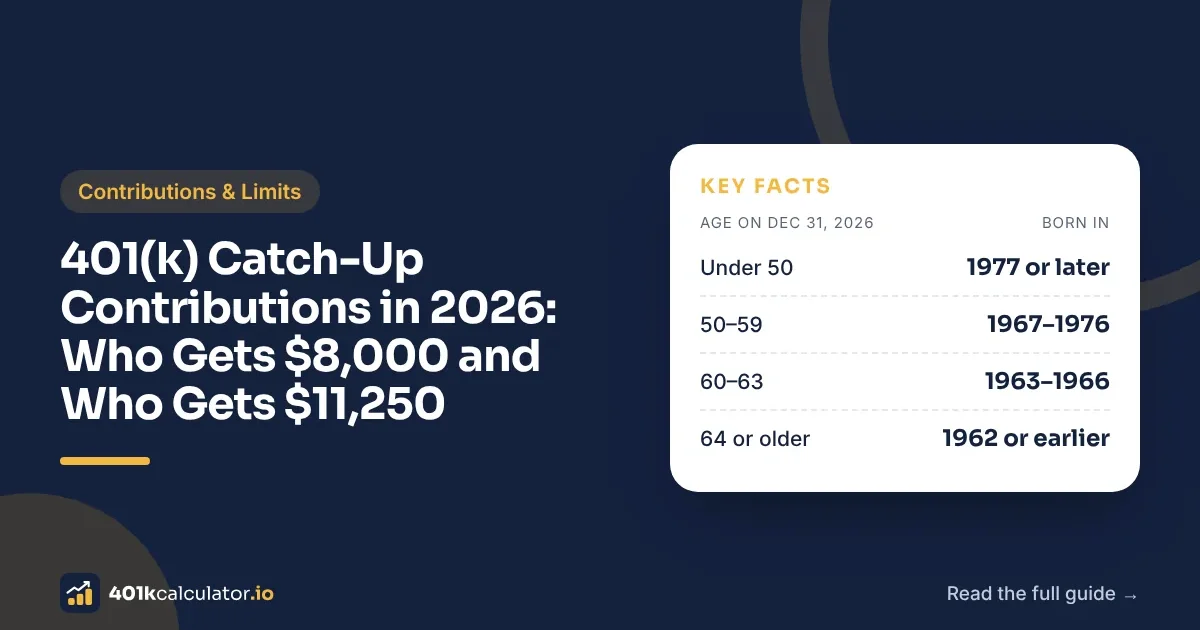
Catch-up contributions let older workers save more than the standard 401(k) limit. In 2026, the standard limit is $24,500. If you are 50 or older, you can add $8,000. If you are 60, 61, 62 or 63, you can add $11,250 instead, thanks to the SECURE 2.0 Act.
2026 Catch-Up Amounts at a Glance
| Age on Dec 31, 2026 | Born in | Catch-up | Total you can defer |
|---|---|---|---|
| Under 50 | 1977 or later | $0 | $24,500 |
| 50–59 | 1967–1976 | $8,000 | $32,500 |
| 60–63 | 1963–1966 | $11,250 | $35,750 |
| 64 or older | 1962 or earlier | $8,000 | $32,500 |
Your age is measured on the last day of the year. If you turn 50 on December 30, 2026, you can make the full $8,000 catch-up for all of 2026.
How the “Super Catch-Up” Works
The higher catch-up for ages 60–63 started in 2025. It is not 150% of the regular catch-up every year, because it is indexed separately. For 2026 it stayed at $11,250 while the regular catch-up rose to $8,000.
It is a four-year window. In the year you turn 64, your catch-up returns to the regular amount.
Example. Linda was born in 1965. She turns 61 in 2026, so she can defer up to $35,750. Her colleague Raj was born in 1962 and turns 64 in 2026, so his maximum is $32,500.
Is the Catch-Up Automatic?
Not always. Your plan must offer catch-up contributions (most do), and you usually need to raise your contribution rate so that your total goes above $24,500. Many payroll systems stop your contributions once you reach $24,500 unless you are flagged as catch-up eligible. Check your plan portal or ask HR.
The age 60–63 super catch-up is optional for employers. If your plan has not adopted it, your catch-up may be limited to $8,000.
The Roth Requirement for Higher Earners
From 2026, if your 2025 FICA wages from your current employer were more than $150,000, your catch-up contributions must be made as Roth contributions. If your plan has no Roth option, you may not be able to make catch-up contributions at all. Full details: The Roth Catch-Up Rule.
How Much Difference Can Catch-Ups Make?
Suppose you contribute an extra $8,000 a year from age 50 to 59, then $11,250 a year from 60 to 63, and the money earns 7% a year. Use our 401(k) calculator with your own age and balance to see the effect; it applies the right catch-up amount for each year of your age automatically.
Catch-Ups and the Employer Match
Your employer may or may not match catch-up contributions. Plans calculate the match on your pay, not on whether a dollar is a catch-up dollar, so it depends on your plan’s formula. If your match is “50% of contributions up to 6% of pay,” your match is capped by the 6% of pay no matter how much you defer.
Checklist for 2026
FAQs
Can I make catch-up contributions to an IRA too? Yes. The 2026 IRA catch-up is $1,100, on top of the $7,500 IRA limit. It is separate from the 401(k) catch-up.
Do I need to be behind on savings to use catch-ups? No. Anyone who meets the age rule can use them.
Does the 60–63 catch-up apply to 403(b) and 457 plans? Yes, it applies to 401(k), 403(b), governmental 457(b) plans and the Thrift Savings Plan, if the plan allows it.
Sources: IRS – IR-2025-111 · IRS – Catch-up contributions
Last reviewed: 12 Nov 2026 · Written and fact-checked by Zeeshan Nawaz