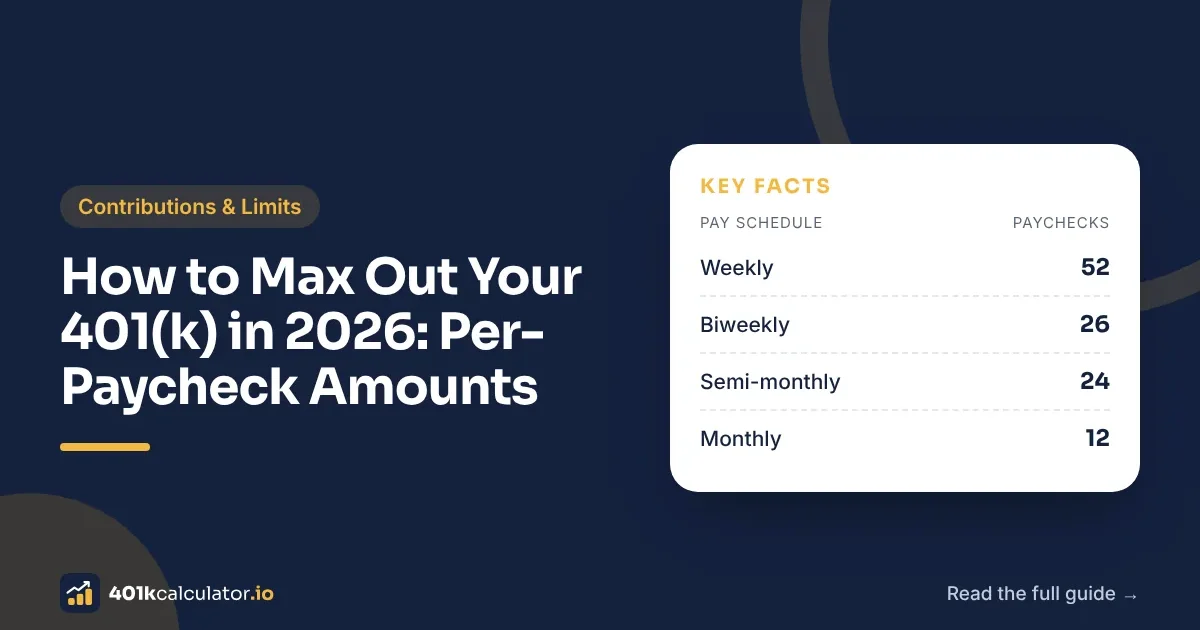
To max out your 401(k) in 2026, you need to contribute $24,500 over the year, or more if you are 50 or older. The easiest way is to divide your annual limit by the number of paychecks you get.
Per-Paycheck Amounts for 2026
| Pay schedule | Paychecks | Under 50 ($24,500) | 50–59 or 64+ ($32,500) | 60–63 ($35,750) |
|---|---|---|---|---|
| Weekly | 52 | $471.15 | $625.00 | $687.50 |
| Biweekly | 26 | $942.31 | $1,250.00 | $1,375.00 |
| Semi-monthly | 24 | $1,020.83 | $1,354.17 | $1,489.58 |
| Monthly | 12 | $2,041.67 | $2,708.33 | $2,979.17 |
What Percentage of Salary Do You Need?
Divide your annual limit by your salary:
Contribution % = Annual limit ÷ Salary × 100
| Salary | % to reach $24,500 |
|---|---|
| $60,000 | 40.8% |
| $80,000 | 30.6% |
| $100,000 | 24.5% |
| $150,000 | 16.3% |
| $200,000 | 12.25% |
If your plan only accepts whole percentages, round up and make sure the plan stops you at the limit, or round down and add a small fixed amount later in the year.
Don’t Max Out Too Early (Unless You Have a True-Up)
Many employers calculate the match per paycheck. If you hit $24,500 in September, your contributions stop and so does your match for October through December, unless your plan makes a “true-up” contribution at year-end.
Example: on a $150,000 salary with a 4% match, front-loading at 25% per paycheck can cost about $2,077 in match without a true-up. See the full example in 401(k) True-Up Contributions.
Starting Mid-Year or After a Raise
If you start maxing out partway through the year, divide what’s left by the paychecks remaining:
Per-paycheck amount = (Annual limit − Contributed so far) ÷ Paychecks left
Example: you’ve contributed $9,000 by July and have 12 biweekly paychecks left. ($24,500 − $9,000) ÷ 12 = $1,291.67 per paycheck.
Changed Jobs This Year?
Your limit is per person, not per plan. Add what you contributed at your old job before setting your new rate. Over-contributing creates an excess deferral that must be corrected by April 15 of the next year. See 401(k) Contribution Limits 2026.
Is Maxing Out Right for You?
Maxing out makes the most sense when you already have an emergency fund, no high-interest debt and your other goals are covered. If not, start with how much to contribute. To see what maxing out could grow to, enter $24,500 a year in our 401(k) calculator.
After you change your contribution, check your next pay stub to confirm the new amount. Tuff Search explains how to read a pay stub line by line.
FAQs
Does the employer match count toward maxing out? No. “Maxing out” usually means your own $24,500. The employer match is extra.
Can I max out both a traditional and a Roth 401(k)? No. They share a single $24,500 limit.
What about a bonus? Some plans take your contribution percentage from bonuses too. Check whether your plan includes bonuses in eligible pay.
Sources: IRS – IR-2025-111 · Per-paycheck figures calculated by 401kcalculator.io.
Last reviewed: 14 Nov 2026 · Written and fact-checked by Zeeshan Nawaz