A 401(k) is offered by your employer and funded from your paycheck. An IRA (individual retirement account) is one you open yourself at a bank or brokerage. Both give tax advantages, and you can use both at the same time.
Side-by-Side for 2026
| Feature | 401(k) | IRA |
|---|---|---|
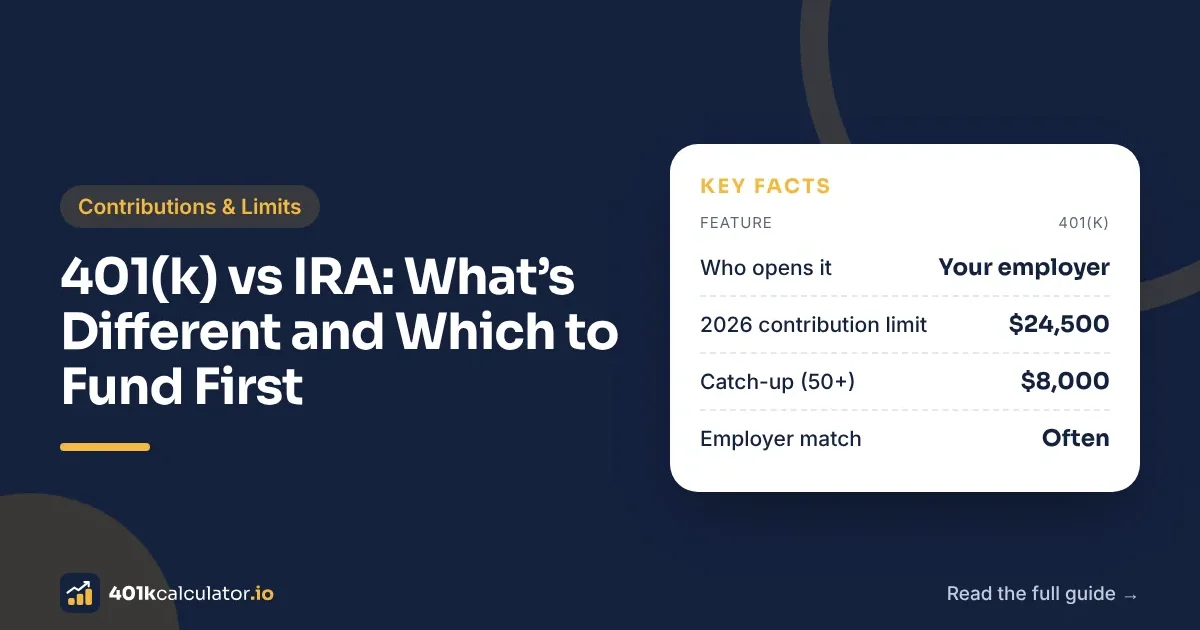
| Who opens it | Your employer | You |
| 2026 contribution limit | $24,500 | $7,500 |
| Catch-up (50+) | $8,000 ($11,250 at 60–63) | $1,100 |
| Employer match | Often | No |
| Investment choices | Limited to plan menu | Wide (stocks, funds, ETFs) |
| Roth version | Roth 401(k), no income limit | Roth IRA, income limits apply |
| Tax deduction for traditional | Always (pre-tax payroll) | May phase out if you or spouse has a workplace plan |
| Loans | Often allowed | Not allowed |
| Penalty-free at 55 after leaving job | Yes (rule of 55) | No |
A Common Funding Order
- 401(k) up to the full employer match. It’s the highest guaranteed return available. See Employer Match Explained.
- IRA (often a Roth IRA if you qualify). More investment choice and often lower fees.
- Back to the 401(k) until you reach $24,500.
- Taxable brokerage account for anything beyond that.
This order isn’t right for everyone. If your 401(k) has very low-cost funds, filling it before an IRA can be just as good.
IRA Income Limits That Matter in 2026
- Roth IRA: phase-out from $153,000–$168,000 (single) and $242,000–$252,000 (married filing jointly).
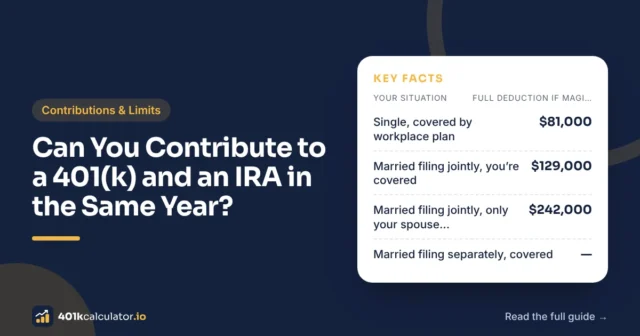
- Traditional IRA deduction if you’re covered by a workplace plan: phase-out from $81,000–$91,000 (single) and $129,000–$149,000 (married filing jointly).
Full details in Can You Contribute to a 401(k) and an IRA in the Same Year?
When You Leave a Job
You can usually roll your old 401(k) into an IRA to get more investment choices and keep everything in one place. See the 401(k) Rollover Guide.
To see how much a 401(k), an IRA or both could grow to by retirement, run your numbers in the 401(k) calculator.
FAQs
Can I have both a 401(k) and an IRA? Yes. The limits are separate: up to $24,500 in the 401(k) and $7,500 in IRAs in 2026.
Which is better if my employer doesn’t match? Compare fees and fund choices. An IRA often has more options; a 401(k) has a much higher limit.
Do Roth IRA income limits apply to Roth 401(k)? No. Anyone can contribute to a Roth 401(k) if the plan offers it.
Sources: IRS – IR-2025-111 · IRS – Retirement plans FAQs regarding IRAs
Last reviewed: 17 Nov 2026 · Written and fact-checked by Zeeshan Nawaz