Starting in 2026, some workers aged 50 and older must make their 401(k) catch-up contributions as Roth contributions. The rule comes from Section 603 of the SECURE 2.0 Act. It applies if your FICA wages from your current employer were more than $150,000 in 2025.
Your regular contributions (up to $24,500) are not affected. You can still make those pre-tax.
Who Is Affected?
You are affected in 2026 if all three are true:
- You are 50 or older by December 31, 2026.
- You want to make catch-up contributions.
- Your 2025 FICA wages (Box 3 of your W-2) from the employer sponsoring your plan were more than $150,000.
Why “FICA Wages” and Not Salary?
The test uses wages subject to Social Security tax, shown in Box 3 of your W-2. This can differ from your salary. Box 3 is capped at the Social Security wage base and is not reduced by 401(k) deferrals.
Two groups are often outside the rule:
- Self-employed people with no W-2 wages from the plan sponsor, such as partners and sole proprietors.
- People who changed jobs. The test looks at wages from the employer sponsoring the plan. If you joined a new employer in 2026, you had no 2025 wages from them.
Three Examples
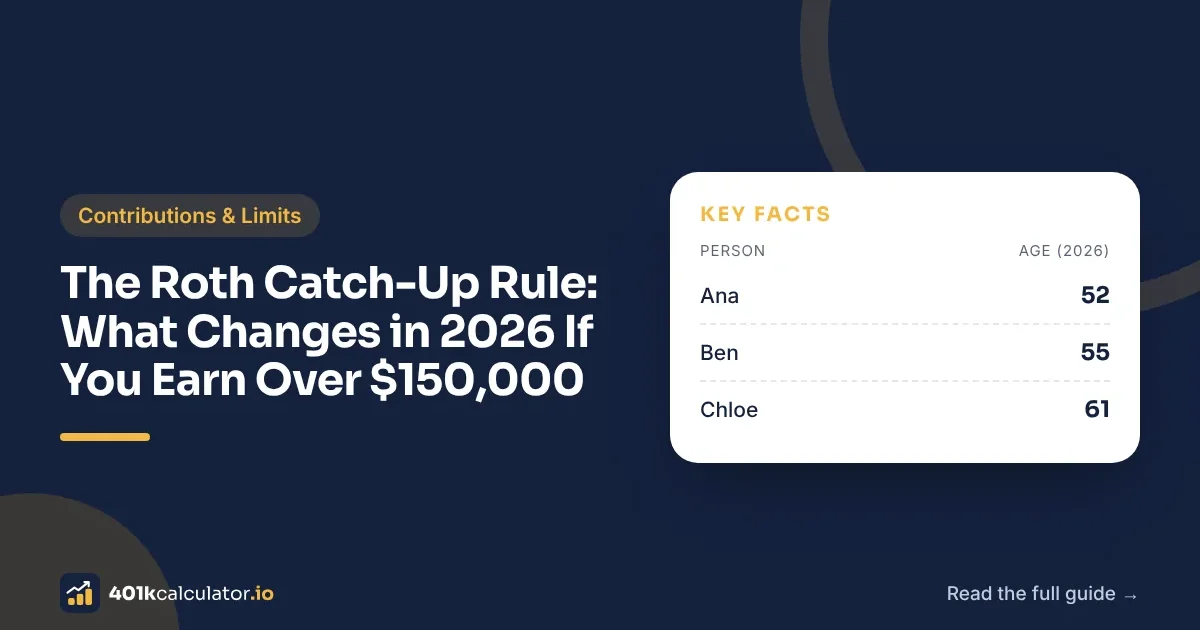
| Person | Age (2026) | 2025 FICA wages from current employer | Result |
|---|---|---|---|
| Ana | 52 | $140,000 | Can make her $8,000 catch-up pre-tax or Roth |
| Ben | 55 | $170,000 | Catch-up must be Roth |
| Chloe | 61 | $160,000 at her old employer, but she joined a new employer in March 2026 | No 2025 wages from new employer, so not required to be Roth at that employer |
What If My Plan Has No Roth Option?
The law does not require plans to add Roth contributions. But if a plan has no Roth option, higher earners covered by the rule cannot make catch-up contributions there. Most large plans already offer Roth 401(k). Check your plan’s summary or portal.
Is Roth Bad for You?
Not necessarily. Roth contributions are taxed now, but qualified withdrawals (after age 59½ and five years) are tax-free. They are also free from required minimum distributions while you are alive. The main cost is losing the current-year deduction on the catch-up amount.
Example. Ben contributes an $8,000 catch-up. If he is in the 24% federal bracket, making it Roth instead of pre-tax raises his 2026 federal tax by about $1,920 ($8,000 × 24%). In exchange, that $8,000 and its growth can come out tax-free later.
See the full comparison in Roth 401(k) vs Traditional 401(k).
What You Should Do Now
- Find your 2025 W-2 and look at Box 3 from your current employer.
- If it was over $150,000, expect your plan to route catch-ups to Roth. Your employer may ask you to make a new election.
- Plan for slightly lower take-home pay, because Roth contributions don’t reduce taxable income. See how contributions change your take-home pay.
- Use the 401(k) calculator to see how your total balance changes with catch-ups included.
The income test looks at your prior-year FICA wages from the employer that sponsors the plan, which is not the same as your total income. Tuff Search explains how FICA tax works if you want the background.
FAQs
Does the $150,000 threshold change each year? Yes. It is indexed for inflation. It was $145,000 in the original law and is $150,000 for determining 2026 catch-ups.
Do my regular contributions have to be Roth too? No. Only the catch-up portion is affected.
Does this apply to IRAs? No. IRA catch-ups are not covered by this rule.
Sources: IRS – IR-2025-111 (threshold for 2026) · IRS – IR-2025-91: final regulations on the Roth catch-up rule
Last reviewed: 13 Nov 2026 · Written and fact-checked by Zeeshan Nawaz