A 401(k) projection usually shows a big number in future dollars. Inflation means each of those dollars will buy less than a dollar does today. Converting the result to today’s dollars tells you what it will actually feel like.
What $1 Million Is Worth in Today’s Dollars
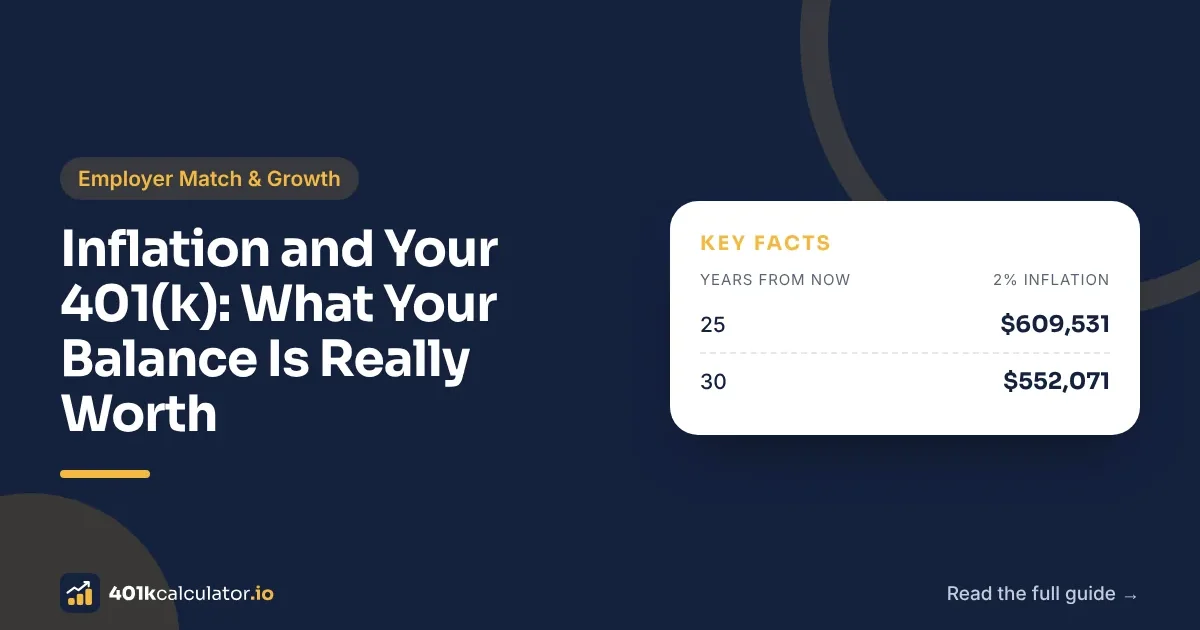
| Years from now | 2% inflation | 3% inflation |
|---|---|---|
| 25 | $609,531 | $477,606 |
| 30 | $552,071 | $411,987 |
The formula:
Today’s value = Future value ÷ (1 + inflation)^years
Example: $1,000,000 ÷ (1.03)^30 ≈ $411,987.
Why This Matters for Planning
If your goal is “$1 million by 65,” the goal itself loses value each year you wait. It’s more useful to set a goal based on income you’ll need in today’s dollars, then let the calculator convert.
For example, our homepage example shows a projected $1,639,996 at 65, which is about $691,047 in today’s dollars at 2.5% inflation. See the calculator.
How a 401(k) Can Keep Up With Inflation
- Invest for growth while you have time. Over long periods, diversified stock investments have historically grown faster than inflation, though with more short-term risk.
- Raise contributions as your pay rises. Saving a fixed percentage of salary does this automatically.
- Watch IRS limits rise. Contribution limits are adjusted for inflation most years.
Social Security and Inflation
Social Security benefits get annual cost-of-living adjustments. Your 401(k) withdrawals don’t adjust automatically, so plan your withdrawals with inflation in mind. See How Much Do I Need to Retire?
Inflation affects cash savings too. Tuff Search shows how inflation affects savings with examples.
FAQs
What inflation rate should I use? Many planners use 2–3%. Try both to see the range.
Should I use a real return or convert at the end? Either works. Our calculator uses a nominal return and converts the final balance to today’s dollars.
Sources: Calculations by 401kcalculator.io.
Last reviewed: 20 Nov 2026 · Written and fact-checked by Zeeshan Nawaz