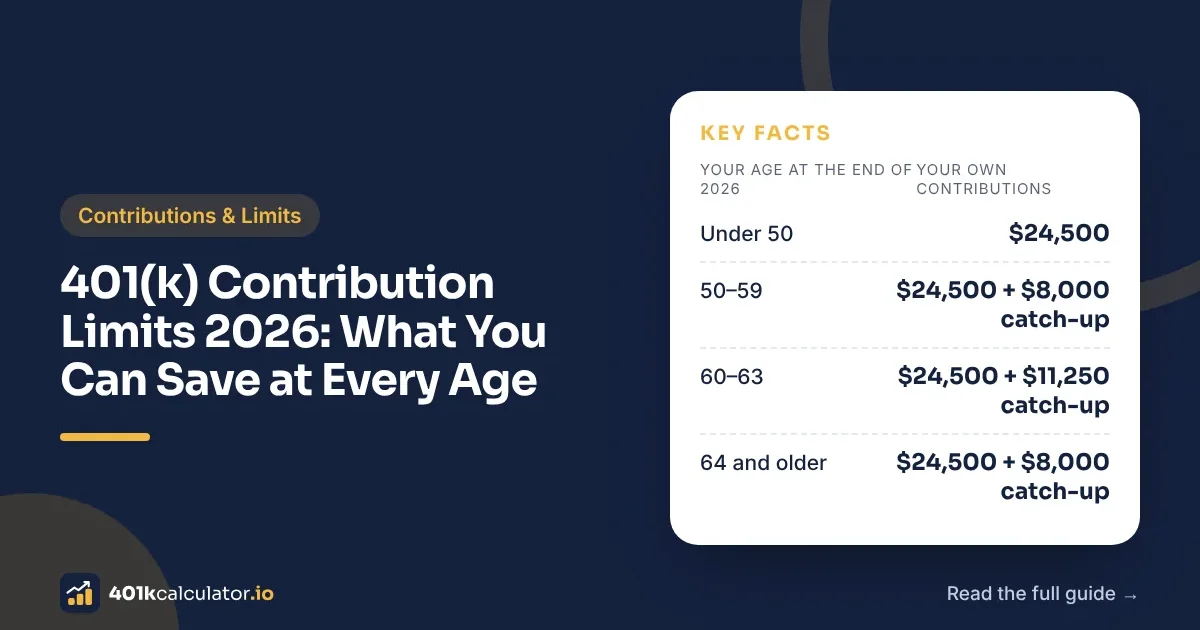
For 2026, you can put up to $24,500 of your own pay into a 401(k). If you are 50 or older, you can add a catch-up contribution of $8,000. If you turn 60, 61, 62 or 63 during 2026, your catch-up is $11,250 instead.
These limits come from IRS Notice 2025-67, released on November 13, 2025. Below is every number that matters, who it applies to, and how to check whether you are on track to hit it.
2026 401(k) Limits by Age
| Your age at the end of 2026 | Your own contributions | Maximum you can defer |
|---|---|---|
| Under 50 | $24,500 | $24,500 |
| 50–59 | $24,500 + $8,000 catch-up | $32,500 |
| 60–63 | $24,500 + $11,250 catch-up | $35,750 |
| 64 and older | $24,500 + $8,000 catch-up | $32,500 |
The $24,500 limit is shared by pre-tax (traditional) and Roth 401(k) contributions. You can split your money between them, but the combined total can’t go over the limit.
The same employee limit applies to 403(b) plans, most governmental 457 plans and the federal Thrift Savings Plan.
The Other 2026 Limits
| Limit | 2026 | 2025 |
|---|---|---|
| Employee deferral (402(g)) | $24,500 | $23,500 |
| Catch-up, age 50+ | $8,000 | $7,500 |
| Catch-up, ages 60–63 | $11,250 | $11,250 |
| Total from you + employer (415(c)) | $72,000 | $70,000 |
| Compensation limit (401(a)(17)) | $360,000 | $350,000 |
| Highly compensated employee threshold | $160,000 | $160,000 |
Total limit ($72,000). This caps everything that goes into your account in a year from all sources: your deferrals, employer match, profit sharing and any after-tax contributions. Catch-up contributions sit on top of this limit, so someone aged 50–59 can reach $80,000 in total, and someone aged 60–63 can reach $83,250.
Compensation limit ($360,000). Your employer can only use the first $360,000 of your pay when calculating matching or profit-sharing contributions.
A New Rule for Higher Earners in 2026
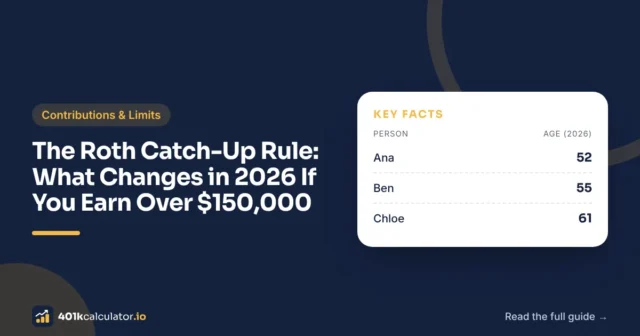
Starting in 2026, if you earned more than $150,000 in FICA wages in 2025 from the employer that sponsors your plan, any catch-up contributions you make must be Roth (after-tax). Your regular $24,500 can still be pre-tax. We explain this in detail in The Roth Catch-Up Rule for $150,000+ Earners.
Does the Employer Match Count Toward $24,500?
No. Employer contributions do not reduce your $24,500 personal limit. They count only toward the $72,000 total. For example, if you contribute $24,500 and your employer adds $6,000, you have used $30,500 of the $72,000 total limit.
What Happens If You Go Over?
If you contribute more than the limit, usually because you changed jobs mid-year and contributed to two plans, the extra amount is called an excess deferral. You should ask a plan to return the excess (plus any earnings) by April 15 of the following year. If it isn’t corrected in time, the same money can be taxed twice.
Your personal limit applies across all 401(k) and 403(b) plans you join in a year, not per plan.
What About 2027?
As of November 1, 2026, the IRS has not announced the 2027 limits. Industry forecasts from Milliman and others project the employee limit rising to about $25,500, but that is a projection, not an official number. We will update this article and our 401(k) calculator as soon as the IRS publishes the 2027 figures.
How to Use These Limits in Your Planning
- Check your current contribution rate. Multiply your salary by your rate. If the result is below $24,500 and you can afford more, you have room to save.
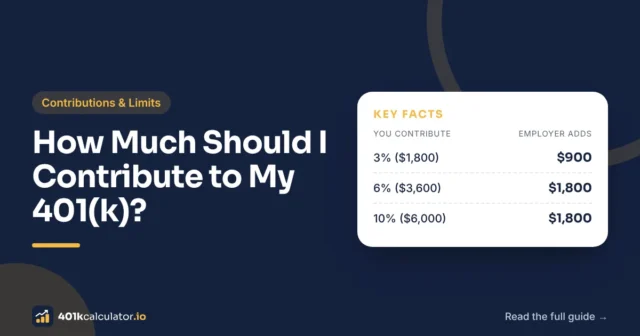
- Make sure you collect the full match. That comes before maxing out. See how employer matching works.
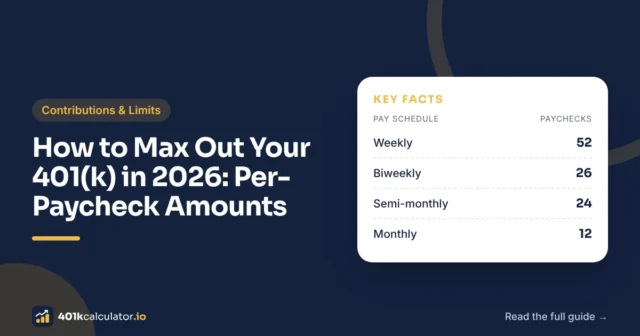
- Spread contributions over the year. Our guide to maxing out your 401(k) per paycheck shows the amounts.
- Turning 50 or 60 soon? Review the catch-up rules before your birthday year begins.
To see what contributing at the limit could add up to by retirement, enter your numbers in our 401(k) calculator. It applies the right limit for your age each year.
Want to see what a bigger contribution does to each paycheck after federal, state and FICA taxes? Try Tuff Search’s state paycheck calculators, then project the long-term balance with our 401(k) calculator.
FAQs
Is the 2026 401(k) limit per person or per plan? Per person. The $24,500 limit covers all your 401(k), 403(b) and similar deferrals in the year, even if you work for two employers.
Can I contribute $24,500 to a traditional 401(k) and another $24,500 to a Roth 401(k)? No. Traditional and Roth 401(k) contributions share one $24,500 limit.
When does the age-60 catch-up start? You qualify for the $11,250 catch-up in any year you will be 60, 61, 62 or 63 on December 31. In the year you turn 64, the catch-up goes back to $8,000.
Does the limit apply to self-employed people? Yes, for the employee part of a Solo 401(k). Self-employed people can also add employer contributions up to the $72,000 total. See Solo 401(k) contribution rules.
Sources: IRS – 401(k) limit increases to $24,500 for 2026 (IR-2025-111) · IRS – Retirement topics: contribution limits · IRS – Correcting excess deferrals
Last reviewed: 12 Nov 2026 · Written and fact-checked by Zeeshan Nawaz