A good starting answer: contribute at least enough to get your full employer match, then work up to about 15% of your pay, counting the match. That 15% figure is the savings rate Fidelity uses in its widely cited retirement guidelines. If you can go further, the 2026 maximum is $24,500 (more if you are 50+).
The right number for you depends on your age, your other debts and how much you already have saved. Here is a simple ladder to work through.
Step 1: Get the Full Match
Your employer match is part of your pay. If you contribute less than the match requires, you leave it on the table.
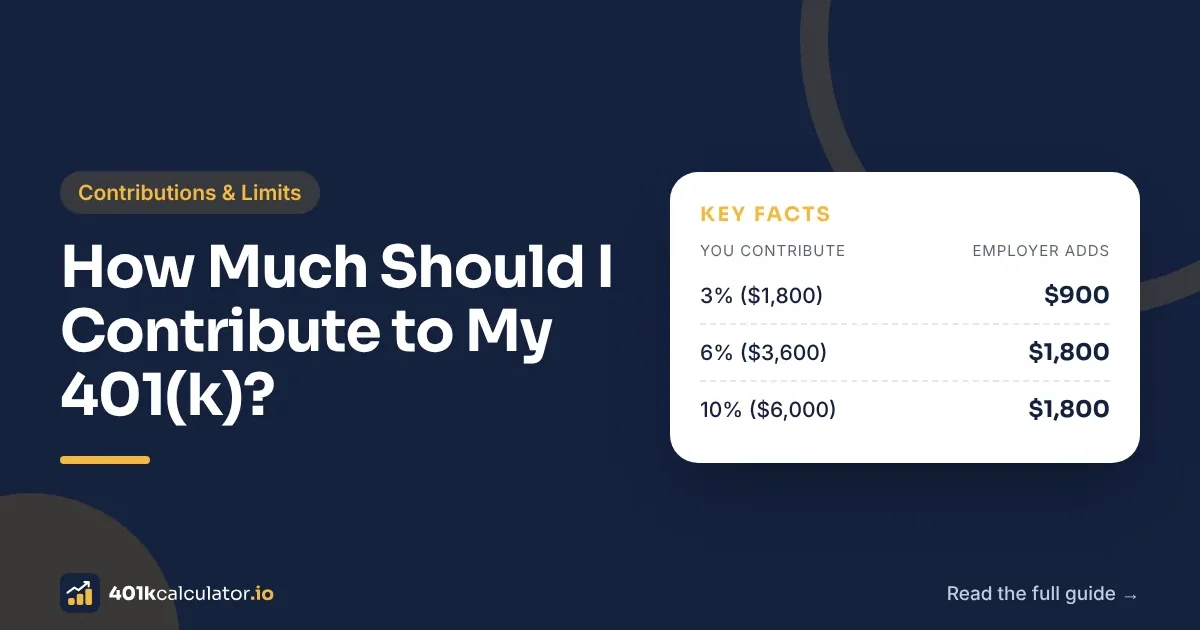
Example: your employer matches 50% of what you contribute, up to 6% of salary. On a $60,000 salary:
| You contribute | Employer adds | Total going in |
|---|---|---|
| 3% ($1,800) | $900 | $2,700 |
| 6% ($3,600) | $1,800 | $5,400 |
| 10% ($6,000) | $1,800 | $7,800 |
Going from 3% to 6% doubles the employer’s contribution. Learn the common formulas in Employer 401(k) Match Explained.
Step 2: Build a Small Emergency Fund
Before going much above the match, many people keep a few months of expenses in savings. Without one, a surprise bill could push you toward a 401(k) loan or an early withdrawal, both of which can be costly.
Step 3: Pay Off High-Interest Debt
Credit card interest is often far above the long-term return you can reasonably expect from investments. Paying it down is a guaranteed “return.”
Step 4: Work Toward 15% Including the Match
With the match in Step 1, you might already be at 9% (6% from you + 3% from the employer). Raising your own rate by 1% a year gets you to 15% within a few years.
Step 5: Consider Maxing Out
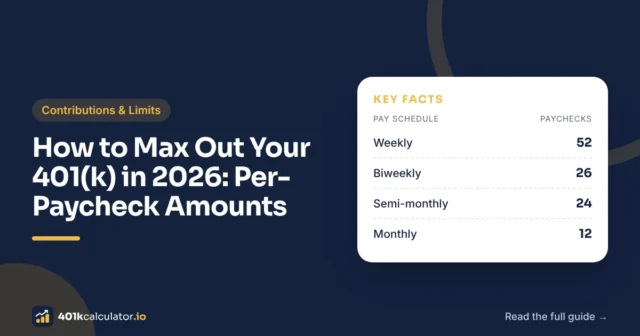
If you have room, the 2026 limit is $24,500, or $32,500 at 50+ and $35,750 at 60–63. See the per-paycheck amounts in How to Max Out Your 401(k).
What If You’re Starting Late?
If you are in your 40s or 50s with little saved, 15% may not be enough to reach a comfortable target. Compare your balance with the savings benchmarks by age, then use the 401(k) calculator to test higher rates and catch-up contributions.
How Contributions Feel in Your Paycheck
Traditional 401(k) contributions come out before federal income tax, so a $100 contribution costs you less than $100 in take-home pay. In the 12% bracket, it costs about $88. See How 401(k) Contributions Change Your Take-Home Pay.
Quick Answers by Situation
| Situation | Reasonable target |
|---|---|
| Just starting, tight budget | Full match, then +1% per year |
| Stable income, no high-interest debt | 15% including match |
| Behind on savings, 45+ | 15–20%+, use catch-ups at 50 |
| High earner wanting tax deferral | The annual maximum |
Before you go beyond the match, make sure you have some cash set aside for emergencies. Tuff Search’s guide to how big an emergency fund should be can help you set that target.
FAQs
Is 10% enough? It can be, especially with a match and an early start. Run your numbers in the calculator to see if 10% reaches your goal.
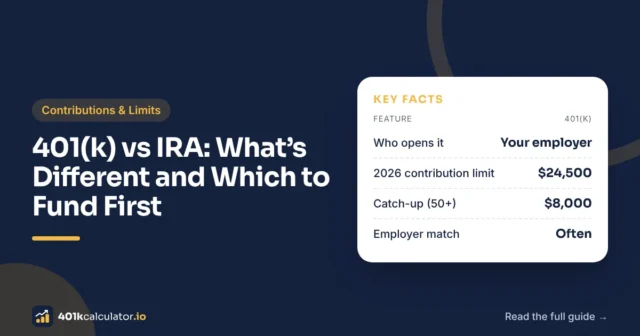
Should I contribute if my employer doesn’t match? Often yes, because of the tax benefits, but compare with an IRA, which may offer more investment choices. See 401(k) vs IRA.
Can I change my contribution rate anytime? Most plans let you change it at any time or at set intervals. Check your plan rules.
Sources: Fidelity – How much do I need to retire? · IRS – 2026 limits (IR-2025-111)
Last reviewed: 13 Nov 2026 · Written and fact-checked by Zeeshan Nawaz